Best AI Bookkeeping Software for S-Corp Owners

Your S-Corp is making money. Your customers are happy. Business is growing.
So why does your bookkeeping still feel like a second job?
Every week, transactions pile up. Receipts end up in email threads and camera rolls. Expenses need to be categorized. Bank statements need to be reconciled. And when tax season approaches, suddenly those “I’ll deal with it later” bookkeeping tasks become a very expensive priority.
For many S-Corp owners, the problem isn’t that bookkeeping is impossible. It’s that too much of it still depends on them.
That’s exactly where AI bookkeeping software comes in.
Today’s AI-powered bookkeeping tools can automate many of the repetitive tasks that once consumed hours, helping categorize transactions, organize financial data, reconcile accounts, identify unusual activity, and keep your books more up to date.
But there’s an important catch: AI bookkeeping software isn’t automatically good bookkeeping software for an S-Corp.
Your business structure creates specific financial and reporting considerations, from owner compensation and payroll to business expenses and tax-ready financial records. The right software needs to do more than simply “use AI.” It needs to help you maintain accurate books while giving you more time to focus on running the business.
Best AI Bookkeeping Software for S-Corp Owners
There isn’t one bookkeeping platform that’s perfect for every S-Corp.
Your best choice depends on the size of your business, transaction volume, whether you have employees, how involved your accountant is, and how much bookkeeping you want to automate.
Here are some of the options worth considering.
1. KeeBooks, Best for AI-Assisted Bookkeeping Workflows
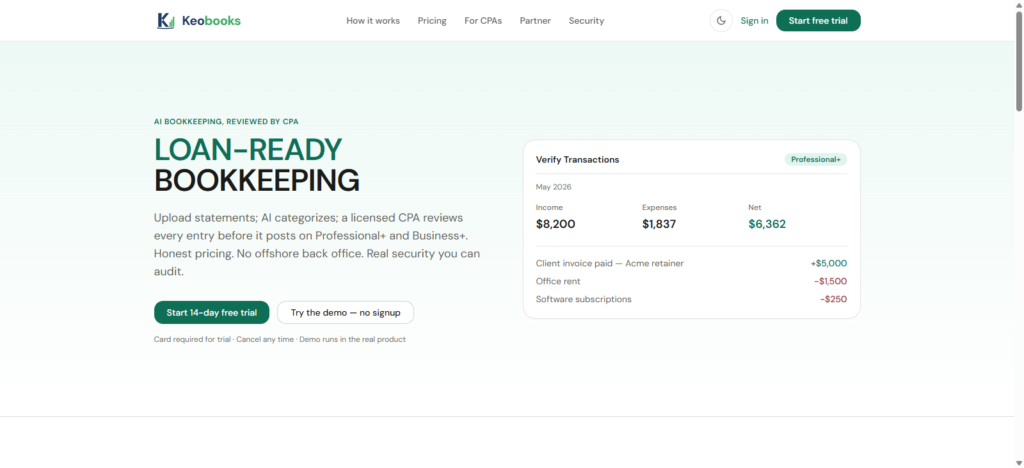
Best for: S-Corp owners who want to reduce manual bookkeeping while keeping human oversight.
KeeBooks stands out because its approach to AI bookkeeping isn’t simply “let AI do everything.”
Instead, the platform is designed around a workflow:
Capture → Organize → Review Exceptions → Report & Collaborate
That approach is particularly appealing for business owners who don’t want to blindly trust an AI-generated accounting entry.
KeeBooks can help capture invoices, receipts, and transaction data, organize financial information, suggest categorizations, identify potential issues, and route uncertain items for review.
Why S-Corp Owners May Like KeeBooks
a. Less repetitive bookkeeping
The system handles more of the routine work so you’re not manually processing every transaction.
b. AI that learns from corrections
When you approve or correct classifications, KeeBooks can use those decisions to make future routine transactions more consistent.
c. Exception-first review
Instead of spending your time checking everything, you can focus on transactions that actually require attention.
d. Documents stay connected
Receipts and invoices can remain connected to the relevant bookkeeping records, reducing the classic “Where’s that receipt?” problem.
e. Built for accountant collaboration
Your bookkeeper or CPA can work within the same system rather than relying on endless exports, spreadsheets, and email attachments.
f. Auditability
KeeBooks emphasizes traceable changes, approvals, and decisions, giving you greater visibility into what changed and who changed it.
For an S-Corp owner, that combination can be more valuable than simply having an AI chatbot attached to an accounting platform. See how it works.
2. QuickBooks, Best for a Mature Accounting Ecosystem
QuickBooks is one of the most established names in small-business accounting software.
Its major advantage is its broad ecosystem, familiarity among accountants, and extensive range of accounting features and integrations.
For an S-Corp owner who already works closely with a CPA who uses QuickBooks, staying within that ecosystem can make sense.
However, established software isn’t necessarily the same thing as the best AI-first bookkeeping experience. If your priority is reducing the amount of routine bookkeeping work you personally have to manage, it’s worth comparing the actual workflow not simply the feature list.
4. Xero, Best for Businesses Wanting Cloud Accounting
Xero is another established cloud accounting platform that can work well for growing businesses.
Its cloud-based approach makes collaboration between business owners and accounting professionals straightforward.
For S-Corp owners evaluating it, the important considerations should include the features you actually need, integrations, reporting, and how well the platform fits your accountant’s existing workflow.
5. FreshBooks, Best for Service-Based Businesses
FreshBooks is particularly well known among freelancers, consultants, agencies, and other service-based businesses.
If your S-Corp primarily invoices clients for services and has a relatively straightforward financial structure, a platform focused on invoicing and expense management may be worth considering.
However, businesses with more complicated accounting requirements should evaluate whether the platform provides everything they need as they grow.
Why KeeBooks Deserves a Closer Look From S-Corp Owners
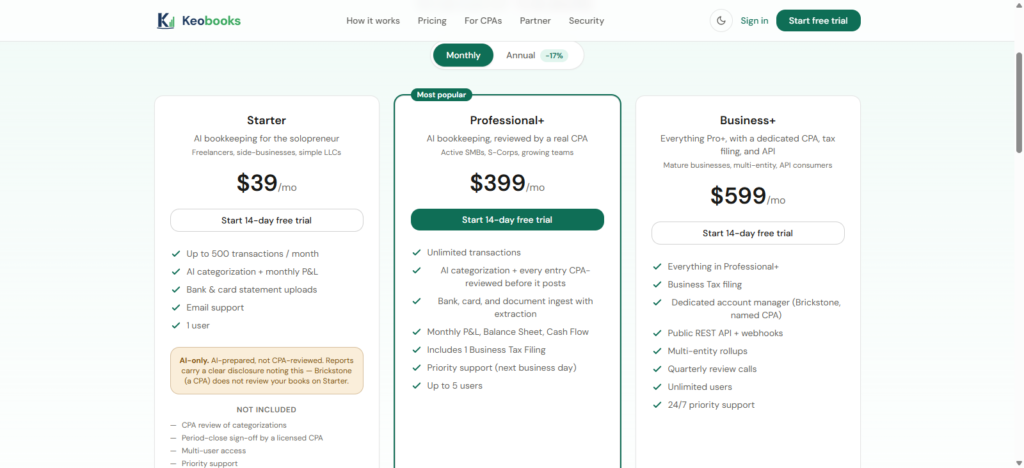
Here’s the fundamental difference between simply adding AI to accounting software and building bookkeeping around AI:
The goal shouldn’t be to eliminate every human decision.
The goal should be to eliminate the decisions that don’t need your attention.
Imagine you have 400 transactions this month.
You don’t necessarily want to manually inspect all 400.
You want the software to recognize the routine transactions, apply consistent logic, and tell you:
“These 365 look normal. These 25 need supporting documents. These 7 appear unusual. And these 3 don’t match the bank activity.”
That’s the philosophy behind KeeBooks’ AI bookkeeping workflow.
The platform describes its approach as exception-first review, routine activity is organized consistently while uncertain items are routed for human review.
For a busy S-Corp owner, that can fundamentally change the bookkeeping experience.
Instead of doing the bookkeeping, you increasingly become the person reviewing what matters.
KeeBooks Doesn’t Ask You to Blindly Trust AI
This is particularly important when you’re dealing with business finances.
An AI system that confidently makes the wrong assumption isn’t necessarily saving you time.
It could be creating more work later.
KeeBooks therefore emphasizes confidence gates and reviewable suggestions. When the system isn’t sufficiently confident, the item can be flagged for clarification or approval.
That creates a more practical relationship between AI and accounting:
AI handles the routine. Humans handle the judgment.
How to Choose the Right AI Bookkeeping Software for Your S-Corp
Before signing up for any platform, ask yourself five questions.
1. How much bookkeeping am I actually doing manually?
If you’re spending several hours every month categorizing transactions, chasing receipts, or preparing information for your accountant, automation could have a meaningful impact.
2. Does the AI explain what it’s doing?
You shouldn’t have to blindly accept an AI-generated classification.
Look for software that lets you review, correct, and understand important decisions.
3. Can my CPA work with me?
Your accountant shouldn’t have to fight the software.
A good platform should make collaboration easier, with appropriate permissions and a clear history of changes.
4. Does it help me find problems early?
Missing receipts and unusual transactions are easier to resolve today than six months later.
5. Can it grow with my business?
Your S-Corp may start with you and one bank account.
That doesn’t mean it will stay that way.
As you add employees, customers, vendors, bank accounts, and transactions, your bookkeeping system should be able to keep up.