How to Prepare Your P&L for a Business Loan

Applying for a business loan can feel a little like putting your business under a microscope.
A lender wants to know how much money your business makes, how much it spends, whether it is profitable, and—most importantly—whether it can comfortably repay the money you borrow.
One of the financial documents that helps answer those questions is your profit and loss statement (P&L).
Your P&L gives a lender a snapshot of your business’s financial performance over a specific period. It shows your revenue, expenses, and resulting profit or loss. But simply handing over a P&L isn’t enough. If the numbers are outdated, inconsistent, incomplete, or difficult to understand, you may create unnecessary questions during the lending process.
The good news is that preparing your P&L for a business loan doesn’t have to be complicated.
With organized bookkeeping, accurate financial records, and the right bookkeeping software, you can create a P&L that gives lenders a clearer picture of your business and helps you understand your own finances before you sit down with a lender.
Here’s how to prepare.
What Is a P&L Statement?
A profit and loss statement, also called an income statement, summarizes a business’s financial performance over a specific period.
At its most basic level, a P&L answers three questions:
- How much revenue did the business generate?
- How much did the business spend?
- Did the business make a profit or a loss?
A typical P&L includes revenue, cost of goods sold, gross profit, operating expenses, and net income.
For example:
| P&L Category | Example |
|---|---|
| Revenue | $250,000 |
| Cost of Goods Sold | $100,000 |
| Gross Profit | $150,000 |
| Operating Expenses | $110,000 |
| Net Profit | $40,000 |
The exact format can vary depending on your business and accounting method, but the basic purpose remains the same: showing how your business performed financially during a defined period.
Why Does Your P&L Matter When Applying for a Business Loan?
Lenders don’t simply want to know that your business makes money. They want to understand the quality and consistency of that income.
A lender may review your financial statements alongside other information to evaluate factors such as your business’s profitability, financial stability, cash flow, existing obligations, and ability to repay the loan.
Your P&L can help demonstrate whether the business has a sustainable source of income.
For example, imagine two businesses are both asking for a $100,000 loan.
Business A generated $500,000 in revenue last year but had inconsistent sales and finished with a small profit.
Business B generated $350,000 but has maintained steady revenue, controlled expenses, and produced consistent profits.
Revenue alone doesn’t tell the whole story.
Your P&L helps provide the context behind the numbers.
That’s why preparing it properly before applying for financing is so important.
1. Make Sure Your Bookkeeping Is Up to Date
Before preparing your P&L, start with the foundation: your bookkeeping.
If your books haven’t been updated in months, your P&L may not accurately reflect your current financial position.
Go through your records and make sure you’ve properly recorded:
- Sales and other income
- Business expenses
- Vendor payments
- Payroll expenses
- Bank transactions
- Credit card transactions
- Refunds and returns
- Loan-related transactions
- Other relevant financial activity
If you use spreadsheets or scattered records to manage your books, this process can become particularly time-consuming.
Using bookkeeping software such as KeoBooks can help keep your financial records organized throughout the year rather than forcing you to reconstruct everything when you need a financial statement.
And that matters when you’re applying for a loan. You don’t want to discover financial discrepancies the week before submitting your application.
2. Reconcile Your Bank and Financial Accounts
Your P&L is only as reliable as the underlying records.
Before relying on the numbers, reconcile your business bank accounts, credit cards, and other relevant financial accounts.
Bank reconciliation involves comparing the transactions recorded in your bookkeeping system with the transactions shown on your bank statement.
Look for:
- Missing transactions
- Duplicate transactions
- Incorrect amounts
- Unrecorded fees
- Incorrect transaction dates
- Transactions recorded in the wrong account
For a growing business with hundreds or thousands of transactions, manually checking everything can become difficult.
This is another area where bookkeeping software can help streamline the process.
With KeoBooks, businesses can keep their financial information organized and make ongoing bookkeeping easier to manage instead of treating reconciliation as a last-minute task before applying for financing.
3. Choose the Right Reporting Period
A P&L isn’t useful without a defined period.
You might prepare a P&L for:
- The previous 12 months
- The current year to date
- A specific quarter
- The previous fiscal year
- Multiple years for comparison
The specific financial statements a lender requests can vary depending on the lender, loan product, and application.
If you’re preparing for a loan application, ask the lender what periods and financial statements they require.
It’s also useful to have more than one period available so you can demonstrate the direction your business is moving.
For example, comparing:
2024 → 2025 → 2026 YTD
can provide more context than looking at a single year’s P&L.
4. Review Your Revenue
Next, examine your revenue carefully.
Make sure the income shown on your P&L accurately represents your business activity for the reporting period.
Look for unusual changes.
Did revenue increase significantly?
Did it decline?
Was there a one-time contract that boosted sales?
Did you add a major customer?
Did you lose an important account?
A lender may notice significant changes in your revenue, so it’s better to understand the story behind your numbers before submitting your financial statements.
If revenue increased dramatically, for example, be prepared to explain why.
Perhaps you expanded into a new market, increased pricing, launched a new service, or acquired a major customer.
The numbers tell the lender what happened.
Your explanation helps them understand why it happened.
5. Review Your Cost of Goods Sold
If your business sells products or services with direct costs, review your cost of goods sold (COGS) carefully.
COGS generally represents costs directly associated with producing or delivering what you sell.
Depending on your business, this could include things such as:
- Inventory
- Materials
- Direct labor
- Manufacturing costs
- Certain fulfillment costs
Your COGS helps determine your gross profit.
For example:
Revenue − COGS = Gross Profit
If your revenue is increasing but COGS is increasing even faster, your margins may be under pressure.
That is important information for both you and the lender.
6. Check Your Operating Expenses
After reviewing revenue and direct costs, examine your operating expenses.
These can include:
- Rent
- Payroll
- Insurance
- Marketing
- Software subscriptions
- Professional services
- Utilities
- Office expenses
- Vehicle expenses
- Travel
- Other operating costs
Look for expenses that appear unusually high or inconsistent.
You should also make sure personal expenses haven’t accidentally been recorded as business expenses.
If something looks unusual on your P&L, investigate it before submitting the statement.
A clean P&L isn’t about making your business look artificially profitable. It’s about presenting accurate and well-organized financial information.
7. Calculate and Review Your Gross Profit
Gross profit can tell you a lot about the economics of your business.
The calculation is straightforward:
Gross Profit = Revenue − Cost of Goods Sold
You can then calculate your gross margin:
Gross Margin = Gross Profit ÷ Revenue × 100
For example, if your business generates $400,000 in revenue and has $160,000 in COGS:
$400,000 − $160,000 = $240,000 gross profit
Your gross margin would be:
$240,000 ÷ $400,000 = 60%
Don’t focus solely on whether the percentage is “good” or “bad.” Compare it with your previous periods and understand why it has changed.
8. Review Your Net Profit
Your bottom-line profit is another important part of the P&L.
Generally:
Revenue − Expenses = Net Profit
Consistent profitability can demonstrate that your business has the capacity to generate income after paying its operating expenses.
However, don’t assume that a single profitable month automatically makes your business loan-ready.
Lenders may consider the broader financial picture, including the consistency of your earnings and other financial obligations.
This is why having accurate historical P&Ls can be valuable.
9. Look for Unusual or One-Time Expenses
One-time expenses can distort your P&L.
Perhaps you:
- Purchased new equipment
- Relocated your business
- Paid a large legal bill
- Invested heavily in a new marketing campaign
- Made a major technology investment
- Experienced an unusual repair
Don’t simply remove these expenses because they make your profit look lower.
Instead, understand and document them.
If a lender asks about an unusual expense, you can explain what happened and whether you expect the expense to recur.
Never manipulate your P&L to make your business appear healthier than it actually is.
Accurate financial statements are far more valuable than artificially polished ones.
10. Compare Your P&L With Previous Periods
One of the best ways to understand your P&L is to compare it with previous periods.
For example:
| Metric | 2024 | 2025 | 2026 YTD |
|---|---|---|---|
| Revenue | $250K | $310K | $190K |
| Gross Profit | $120K | $155K | $98K |
| Operating Expenses | $105K | $125K | $76K |
| Net Profit | $15K | $30K | $22K |
This kind of comparison can reveal trends that aren’t obvious from a single statement.
You may discover that:
- Revenue is consistently increasing
- Expenses are growing faster than sales
- Profit margins are improving
- Certain costs are becoming excessive
- Your business has seasonal fluctuations
Keeping this information organized throughout the year makes it much easier to prepare reports when financing opportunities arise.
11. Don’t Forget Your Balance Sheet and Cash Flow
Although this article focuses on the P&L, don’t assume the P&L is the only financial statement a lender may want.
Depending on the lender and loan application, you may also be asked for documents such as:
- Balance sheet
- Cash flow statement
- Business bank statements
- Tax returns
- Accounts receivable information
- Accounts payable information
- Personal financial information
The P&L shows profitability, but profitability isn’t the same thing as cash in the bank.
A business can be profitable on paper and still have cash-flow challenges.
That’s why you should prepare your broader financial records, not just the P&L.
12. Make Sure Your P&L Matches Your Other Financial Records
Consistency matters.
If your P&L shows one amount for revenue but your tax return, bank statements, or other financial records show something dramatically different, you may have to explain the discrepancy.
Before submitting your loan application, review your financial information as a complete package.
Ask:
- Do the numbers make sense?
- Are the reporting periods consistent?
- Are transactions recorded correctly?
- Are expenses categorized appropriately?
- Are there unexplained differences?
- Are all major accounts reconciled?
If you’re unsure, consider having your bookkeeper or accountant review the statements.
13. Use Bookkeeping Software to Stay Loan-Ready
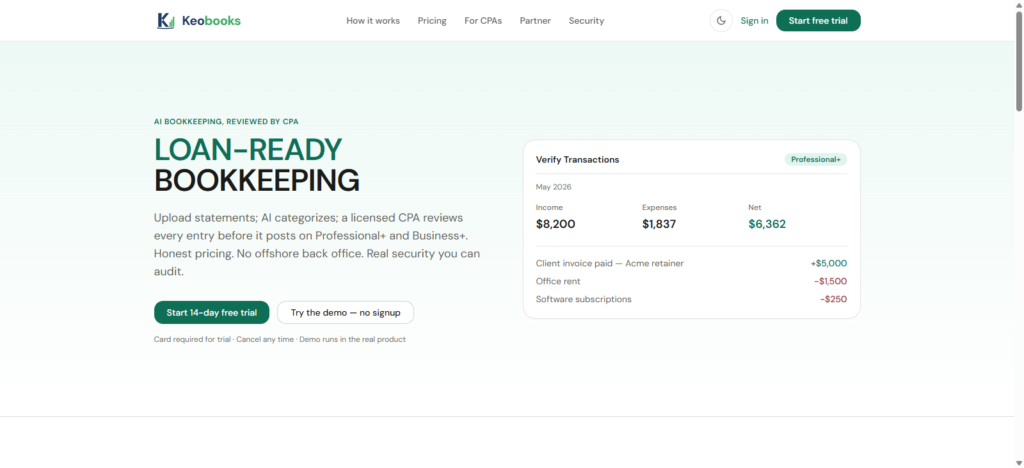
Preparing a P&L shouldn’t be a once-a-year emergency.
If you only organize your books when you need financing, you may spend days trying to reconstruct your financial history.
A better approach is to maintain organized books throughout the year.
This is where KeoBooks can help.
Instead of waiting until a lender asks for financial statements, you can use bookkeeping software to keep your business income and expenses organized, maintain up-to-date financial records, and make it easier to access the information you need.
That means when an opportunity comes along, whether it’s a business loan, new investment, expansion, or simply a need to understand your financial position, you aren’t starting from scratch.
Good bookkeeping isn’t just about preparing for tax season. It’s about keeping your business financially ready for its next opportunity.
14. Work With Your Accountant or Bookkeeper
Software can make bookkeeping more organized and efficient, but it doesn’t replace professional judgment in every situation.
If you’re applying for a significant business loan, consider having a qualified accountant or bookkeeper review your financial statements before submitting them.
They may identify:
- Classification issues
- Missing transactions
- Reconciliation problems
- Unusual expenses
- Reporting inconsistencies
- Other issues that could require clarification
Getting a second set of eyes can give you greater confidence in the information you’re providing.
P&L Preparation Checklist for a Business Loan
Before submitting your P&L, run through this checklist:
Financial records
- Bookkeeping is completely up to date
- Bank accounts are reconciled
- Credit card accounts are reconciled
- Income has been recorded accurately
- Expenses have been recorded accurately
- Personal expenses are excluded
P&L
- Correct reporting period is used
- Revenue has been reviewed
- COGS has been reviewed
- Gross profit has been checked
- Operating expenses have been reviewed
- Net profit has been verified
- Unusual expenses have been identified and understood
Supporting financial information
- Balance sheet is available if required
- Cash flow information is available if required
- Business bank statements are available
- Tax returns are available if requested
- Other lender-required documents are prepared
Final review
- Numbers are consistent across financial records
- Reporting periods are consistent
- Financial statements have been reviewed
- You can explain significant changes in revenue or expenses
A business loan application isn’t the time to discover that your bookkeeping is six months behind.
Your P&L should tell a clear, accurate story about your business: how much you’re generating, what it costs to operate, how profitable you are, and how your financial performance has changed over time.
The strongest preparation starts long before you apply.
Keep your books current. Reconcile your accounts regularly. Review your revenue and expenses. Monitor your profitability. And use bookkeeping software to reduce the amount of manual work involved in maintaining your financial records.
With KeoBooks, you can keep your bookkeeping organized throughout the year, making it easier to understand your numbers and prepare the financial information you need when your next business opportunity comes along.
Don’t wait until you need a loan to get your books in order. Build a bookkeeping system today that keeps your business ready for tomorrow.
Ready to Get Your Books in Order?
Keep your finances organized with KeoBooks and make it easier to stay on top of your business numbers.