KEOBOOKS vs Traditional Bookkeeping Services

For years, small businesses have had a fairly simple choice when it comes to bookkeeping: do it yourself, hire an employee, or pay an outside bookkeeping service to handle the books.
That model still works for many businesses.
A good bookkeeper can keep your records organized, reconcile your accounts, categorize transactions, and prepare financial reports. More importantly, you have a real person you can contact when something doesn’t look right.
But there’s another problem.
Traditional bookkeeping can become expensive, slow, or difficult to scale as your business grows.
A growing company might suddenly have hundreds of transactions to process, more invoices to track, multiple accounts to reconcile, and increasingly complex financial records. Meanwhile, the business owner still wants accurate books without spending thousands of dollars every month on administrative work.
This is where technology and particularly AI-assisted bookkeeping has started changing the way businesses manage their finances.
KEOBOOKS takes a different approach: AI handles much of the repetitive bookkeeping work, while a real US-licensed CPA reviews the books on the Professional+ and Business+ plans.
So, how does KEOBOOKS compare with a traditional bookkeeping service?
Let’s take a closer look.
What Is Traditional Bookkeeping?
Traditional bookkeeping typically involves a person or bookkeeping firm managing your financial records on your behalf.
Depending on the service, a bookkeeper may:
- Record and categorize transactions
- Reconcile bank accounts
- Manage accounts payable and receivable
- Track expenses
- Prepare financial statements
- Maintain your general ledger
- Organize financial documents
- Communicate with your accountant or CPA
For many small businesses, this arrangement works well.
You hand over your financial information, the bookkeeper handles the day-to-day bookkeeping, and you receive updated financial reports.
The biggest advantage is the human element.
You can ask questions, explain unusual transactions, and have someone use their professional judgment when something doesn’t fit neatly into a category.
The downside is that traditional bookkeeping relies heavily on human labor.
More transactions generally mean more work. More work can mean higher fees or longer turnaround times.
And if your bookkeeper is managing dozens of clients, you may not always get an immediate response when you have a question.
What Is KEOBOOKS?
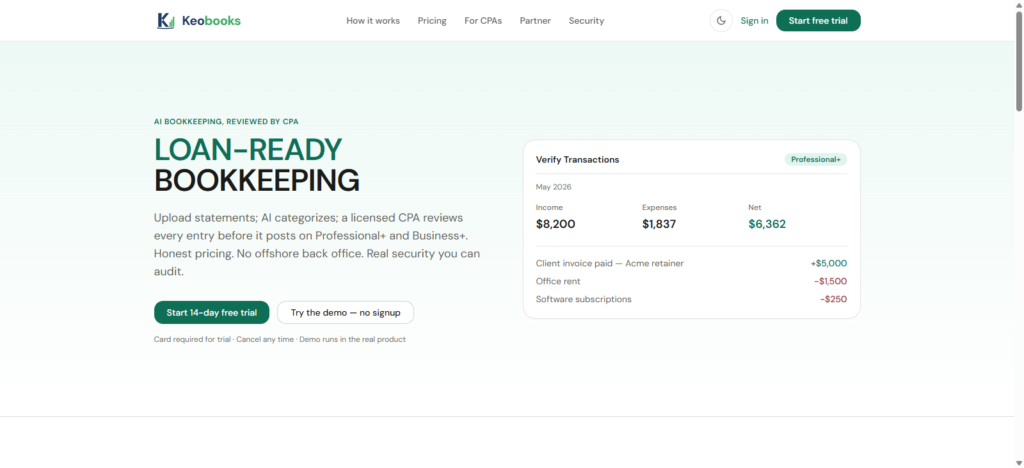
KEOBOOKS is built around a different model.
Instead of relying entirely on manual bookkeeping, KEOBOOKS uses AI to assist with the repetitive parts of the bookkeeping process.
According to KEOBOOKS, its AI can classify documents and propose journal entries, helping speed up the monthly close. On the Professional+ and Business+ plans, those entries are then reviewed by a US-licensed CPA before they post.
That creates a hybrid approach:
AI for speed + CPA review for oversight.
The Starter plan is AI-only, while Professional+ adds CPA review and Business+ includes everything in Professional+ along with a dedicated CPA, tax filing, and API access.
This distinction is important because KEOBOOKS isn’t simply trying to replace a traditional bookkeeper with an algorithm.
It’s attempting to combine automation with human accounting expertise.
KEOBOOKS vs. Traditional Bookkeeping: At a Glance
| Feature | Traditional Bookkeeping | KEOBOOKS |
|---|---|---|
| Transaction categorization | Primarily human | AI-assisted |
| Journal entries | Human-prepared | AI proposes; CPA reviews on Pro+/Business+ |
| CPA involvement | Depends on service | Included on Pro+/Business+ |
| Monthly close | Depends on bookkeeper workload | AI-assisted workflow |
| Human oversight | Yes | Yes on Pro+/Business+ |
| AI automation | Usually limited | Core part of workflow |
| Document processing | Often manual | AI-assisted |
| Dedicated CPA | Depends on provider | Business+ |
| Tax filing | Depends on provider | Business+ |
| Pricing | Varies widely | Published plan pricing |
| Scalability | Often requires additional labor | Automation helps handle repetitive work |
The important thing is that neither approach is automatically right for every business.
The better question is:
Which approach fits the way your business operates today and where you want it to be tomorrow?
1. Human Expertise vs. AI-Assisted Bookkeeping
The biggest difference is how the work gets done.
With a traditional bookkeeping service, much of the bookkeeping process is performed manually by a person.
KEOBOOKS shifts some of that repetitive workload to AI.
The AI can analyze financial documents, classify information, and propose journal entries. A human CPA then provides oversight on the Professional+ and Business+ plans.
This can be particularly useful for businesses with a large volume of routine transactions.
Instead of paying someone to manually process every piece of information, AI can handle the repetitive work while the CPA focuses on reviewing the results.
It’s similar to having an assistant prepare the routine work while an experienced professional checks it before it’s finalized.
2. Speed and Monthly Close
One of the frustrations with bookkeeping is waiting for the books to be updated.
If your books aren’t current, you may not have a clear picture of your business’s financial position.
That can affect decisions about:
- Hiring
- Marketing
- Cash flow
- Expenses
- Pricing
- Business growth
- Financing
Traditional bookkeeping can be perfectly timely when you have a responsive bookkeeper and a manageable workload.
But turnaround can become an issue as transaction volume increases or a bookkeeping firm becomes busy.
KEOBOOKS is designed to accelerate the process through AI-assisted categorization and journal-entry preparation. The company specifically positions this as a way to achieve a faster monthly close while maintaining CPA review on its higher-tier plans.
For a growing business, getting reliable financial information sooner can be more valuable than simply having someone maintain the books.
3. Cost: Traditional Bookkeeping vs. KEOBOOKS
Cost is one of the most obvious differences to consider.
Traditional bookkeeping services can vary significantly in price depending on:
- Transaction volume
- Number of accounts
- Business complexity
- Frequency of bookkeeping
- Geographic location
- Level of expertise
- Whether accounting or tax services are included
Some businesses may pay a few hundred dollars a month, while more complex businesses can spend considerably more.
KEOBOOKS takes a different approach with transparent published pricing.
At the time of writing, KEOBOOKS lists:
- Starter — $39/month
- Professional+ — $399/month
- Business+ — $599/month
The plans aren’t identical, so businesses should compare the features and level of professional involvement rather than looking at price alone.
For example, Professional+ includes AI bookkeeping reviewed by a real CPA, while Business+ adds a dedicated CPA, tax filing, and API access.
The bigger question isn’t simply:
“Which one costs less?”
It’s:
“How much am I paying for bookkeeping, and how much value am I getting from it?”
4. CPA Access and Professional Oversight
This is where KEOBOOKS takes a particularly interesting position.
A completely automated bookkeeping system can be fast, but some business owners may not be comfortable relying entirely on AI for their financial records.
Traditional bookkeeping solves this by putting a person in charge.
KEOBOOKS attempts to bridge the two approaches.
On Professional+ and Business+, KEOBOOKS says every entry is reviewed by Brickstone & Associates, a US-licensed CPA practice.
That means the workflow isn’t simply:
Upload documents → AI makes decisions → Done.
Instead, the model is closer to:
Upload financial information → AI processes and proposes → CPA reviews → Books are finalized.
For a business owner who wants automation without completely removing human oversight, that can be a compelling middle ground.
5. Scalability for Growing Businesses
Traditional bookkeeping can scale, but scaling usually means additional human effort.
If your transaction volume doubles, your bookkeeping workload may increase.
If you add another business entity, additional accounts, employees, or revenue streams, your bookkeeping process may become more complicated.
That doesn’t mean traditional bookkeeping can’t handle growth.
It simply means you need to consider whether the service you’re using can scale with you.
Automation offers another possibility.
Instead of adding more human labor for every repetitive transaction, AI can handle a larger portion of routine processing.
That’s one of the reasons AI bookkeeping software for small businesses is becoming increasingly interesting.
KEOBOOKS is designed around this principle: let AI handle repetitive work while keeping professional review in the workflow where it matters.
6. Security and Auditability
Your bookkeeping system contains some of your company’s most sensitive information.
Bank transactions. Revenue. Expenses. Payroll-related information. Financial statements.
So security shouldn’t be an afterthought.
KEOBOOKS says its platform uses Google Cloud infrastructure along with measures including TOTP two-factor authentication, database-level tenant isolation, signed upload URLs, and an append-only audit trail.
The audit trail is particularly relevant when financial records are being processed with automation.
Businesses should be able to understand what happened to their data and maintain visibility into changes.
Traditional bookkeeping firms can also have strong security practices, of course. The key is to evaluate the specific provider rather than assuming either model is automatically safer.
Who Should Use Traditional Bookkeeping Services?
Traditional bookkeeping remains an excellent option for certain businesses.
It may make sense if:
a. Your Business Is Highly Complex
Businesses with complicated accounting structures may benefit from a dedicated accounting team that understands their specific needs.
b. You Want Extensive Human Support
Some business owners simply prefer having a person they can call whenever they have a bookkeeping question.
That’s a legitimate preference.
c. Your Books Require Significant Judgment
If your financial situation involves unusual transactions or complex accounting requirements, professional human involvement can be particularly valuable.
d. Your Existing Bookkeeper Works Extremely Well
If you already have a trusted bookkeeper who is responsive, accurate, reasonably priced, and understands your business, there’s not necessarily a reason to change just because newer technology exists.
The goal isn’t to automate something that already works perfectly.
Who Should Consider KEOBOOKS?
KEOBOOKS may be particularly attractive to businesses that want to reduce manual bookkeeping work while maintaining professional oversight.
It could be worth considering if:
a. You’re Tired of Manual Bookkeeping
If you’re spending hours every month organizing documents and categorizing transactions, automation can remove much of the repetitive work.
b. You’re Growing Quickly
As transaction volume increases, automation can become more valuable.
c. You Want CPA Oversight
Professional+ and Business+ combine AI-assisted bookkeeping with review by a US-licensed CPA.
d. You Want Predictable Pricing
KEOBOOKS publishes its plan pricing rather than requiring every potential customer to go through a custom quote process.
e. You Want Technology Without Going Fully DIY
This may be the biggest reason to consider the hybrid model.
You don’t necessarily want to hire a traditional bookkeeping firm, but you also don’t want to trust your company’s books entirely to an automated system.
KEOBOOKS sits between those two extremes.
KEOBOOKS vs. Traditional Bookkeeping: Which Is Better?
There’s no universal winner.
Traditional bookkeeping is still valuable because human expertise matters.
A good bookkeeper understands context. They can ask questions, notice unusual activity, and communicate with you about what’s happening in your business.
But technology has changed what bookkeeping can look like.
AI can process repetitive information quickly. It can recognize patterns, classify documents, and prepare work for review.
KEOBOOKS essentially combines these two ideas.
The AI does the heavy lifting. The CPA provides oversight.
That can give growing businesses a way to reduce repetitive bookkeeping work without giving up professional review.
The Future of Small Business Bookkeeping Isn’t Necessarily Human vs. AI
The debate is often framed as:
Should I use AI or a human bookkeeper?
That’s probably the wrong question.
The better question is:
How can technology and accounting professionals work together to give businesses better bookkeeping?
A human-only system can work.
An AI-only system can be fast.
But there is a compelling argument for combining the two.
AI can handle repetitive processing at scale.
A CPA can review the work, catch issues, provide context, and bring professional judgment to the process.
That’s the model behind KEOBOOKS.
And it’s particularly relevant for small businesses that have outgrown DIY bookkeeping but aren’t ready—or don’t want—to build a traditional accounting department.
One thought on “KEOBOOKS vs Traditional Bookkeeping Services”