Bookkeeping vs Accounting: What Does Your Business Actually Need?

When you’re running a small business, there are plenty of things you know you need: customers, sales, a good product or service, and enough cash to keep the lights on.
But then someone asks, “Do you have a bookkeeper or an accountant?”
Suddenly, things get a little less clear.
You may know that both have something to do with your business finances, but what’s the actual difference between bookkeeping and accounting? Do you need both? Can bookkeeping software handle everything? And at what point does your business need an accountant?
These are important questions because bookkeeping and accounting aren’t the same thing. Bookkeeping focuses primarily on recording and organizing your financial transactions, while accounting goes further by interpreting that financial information and helping you make informed financial decisions.
For a small business, understanding the difference can help you spend money on the right financial support at the right time.
And with modern bookkeeping software for small businesses, many routine bookkeeping tasks can now be streamlined or automated, making it easier for business owners to maintain accurate financial records without doing everything manually.
Let’s break down bookkeeping vs. accounting, what each one does, and how to determine what your business actually needs.
What Is Bookkeeping?
Bookkeeping is the process of recording, organizing, and maintaining your business’s financial transactions.
Every time your business earns money or spends money, that activity needs to be recorded properly. Bookkeeping creates the financial records that your business and eventually your accountant can use to understand its financial position.
Typical bookkeeping tasks include:
- Recording sales and income
- Tracking business expenses
- Managing accounts receivable
- Tracking accounts payable
- Recording payments
- Reconciling bank accounts
- Organizing financial transactions
- Maintaining the general ledger
- Preparing basic financial reports
Think of bookkeeping as building the financial foundation of your business.
If the underlying records are incomplete or inaccurate, the financial reports built from those records won’t tell you the full story.
What Does a Bookkeeper Do?
A bookkeeper is primarily responsible for keeping your financial records organized and up to date.
Depending on the business, a bookkeeper may record transactions, reconcile accounts, categorize expenses, manage invoices, track payments, and prepare financial information for an accountant.
For a small business, this can be extremely valuable because bookkeeping can quickly become time-consuming as transaction volume increases.
However, you don’t necessarily need someone manually entering every transaction into a spreadsheet.
Modern small business bookkeeping software can automate many repetitive tasks, allowing business owners and bookkeepers to spend more time reviewing financial information and less time on data entry.
What Is Accounting?
Accounting takes the financial information produced through bookkeeping and turns it into information that can be used for analysis, planning, compliance, and decision-making.
While bookkeeping asks:
“What happened financially?”
Accounting goes a step further and asks:
“What does it mean, and what should we do about it?”
Accounting activities can include:
- Analyzing financial statements
- Preparing financial reports
- Tax planning and preparation
- Budgeting and forecasting
- Financial analysis
- Cash-flow planning
- Business advisory
- Compliance support
- Financial strategy
An accountant may look at your financial statements and help you understand whether your business is profitable, where expenses are increasing, how much cash you have available, and what financial decisions you should consider next.
Bookkeeping vs Accounting: What’s the Difference?
The simplest way to understand the difference is this:
Bookkeeping records the financial activity. Accounting interprets and analyzes that information.
Here’s a quick comparison:
| Bookkeeping | Accounting |
|---|---|
| Records financial transactions | Analyzes financial information |
| Tracks income and expenses | Interprets business performance |
| Reconciles accounts | Prepares and analyzes financial statements |
| Maintains financial records | Supports financial planning |
| Tracks invoices and payments | Helps with tax planning and strategy |
| Focuses on accurate records | Focuses on analysis and decisions |
The two functions work together.
You can think of bookkeeping as collecting the pieces of the puzzle and accounting as putting those pieces together to understand the bigger picture.
Why Bookkeeping Matters for Small Businesses
It can be tempting to treat bookkeeping as administrative busywork.
After all, you’re trying to grow a business. Why spend hours categorizing expenses or reconciling transactions?
Because your financial records affect almost every important business decision you make.
Accurate bookkeeping can help you answer questions such as:
- How much revenue did we generate this month?
- What are our biggest expenses?
- Are customers paying their invoices on time?
- How much cash is available?
- Are we actually profitable?
- Can we afford to hire another employee?
- Which products or services are generating the most revenue?
Without reliable bookkeeping, you’re often making those decisions based on incomplete information.
That’s why maintaining accurate financial records should become more important, not less, as your business grows.
Why Accounting Matters for Small Businesses
Bookkeeping tells you what happened.
Accounting helps you understand what those numbers mean.
For example, imagine your business generated $500,000 in revenue last year.
At first glance, that sounds great.
But an accountant may help you look deeper.
How much did it cost to generate that revenue? What’s your gross profit? What are your operating expenses? How much cash did the business actually generate? Are there tax implications? Are you growing profitably?
Revenue alone doesn’t tell you whether a business is financially healthy.
Accounting provides the analysis behind the numbers.
Do Small Businesses Need a Bookkeeper or an Accountant?
This is where things get interesting.
Not every small business needs the same level of financial support.
A solo business owner with relatively simple finances may be able to manage basic bookkeeping using accounting or bookkeeping software and work with an accountant when needed.
A growing business with employees, inventory, multiple bank accounts, significant transaction volume, or more complex financial requirements may benefit from professional bookkeeping support as well as accounting services.
The right choice depends on your:
- Business size
- Transaction volume
- Industry
- Financial complexity
- Growth stage
- Accounting knowledge
- Tax situation
- Budget
The important thing is not to hire financial help simply because someone says every business “needs” one.
Instead, look at the financial complexity of your business and determine where professional support would create the most value.
When Bookkeeping Software May Be Enough
For many small businesses, bookkeeping software can handle a significant portion of routine financial management.
This is especially true when your financial activity is relatively straightforward.
For example, if you have:
- One primary business
- A manageable number of transactions
- A few bank accounts
- Straightforward income and expenses
- No complicated inventory system
- Relatively simple financial reporting needs
you may be able to handle much of your day-to-day bookkeeping with the right software.
The advantage is that software can help organize financial information while reducing repetitive manual work.
What Can Bookkeeping Software Do?
Depending on the platform, bookkeeping software may help you:
- Track income and expenses
- Manage invoices
- Monitor payments
- Import financial transactions
- Reconcile accounts
- Generate financial reports
- Organize customer information
- Keep financial records in one place
This is where a platform such as KeoBooks can become useful for growing small businesses.
Rather than relying entirely on spreadsheets and manual processes, business owners can use bookkeeping software to create a more organized financial workflow.
When You May Need a Bookkeeper
As your business grows, bookkeeping can become more complicated.
You may want to consider professional bookkeeping support when:
a. Your Transaction Volume Is Increasing
Hundreds of transactions each month can take significantly more time to review and categorize than a few dozen.
b. You’re Spending Too Much Time on Your Books
If bookkeeping is taking several hours every week, consider whether your time would be better spent on sales, operations, marketing, or customers.
c. You Have Employees
Payroll and employee-related expenses can introduce additional financial complexity.
d. You Have Multiple Accounts
Managing several bank accounts, credit cards, payment processors, or merchant accounts creates more transactions that need to be tracked and reconciled.
e. Your Business Has Become More Complex
Inventory, multiple revenue streams, loans, contractors, and other financial activities can make bookkeeping more difficult to manage yourself.
In these situations, bookkeeping software can still be valuable. In fact, it can make a professional bookkeeper more efficient by providing organized records and automated workflows.
When Should You Hire an Accountant?
An accountant can become particularly valuable when your business’s financial decisions become more complex.
You may want an accountant when you need help with:
i. Tax Planning
An accountant can help you understand your tax obligations and plan for them throughout the year.
ii. Financial Statements
If you need detailed financial statements or more advanced financial analysis, professional accounting support may be useful.
iii. Business Growth
If you’re considering hiring employees, opening another location, purchasing equipment, taking on debt, or expanding your business, an accountant can help you understand the financial implications.
iv. Business Structure
Major decisions involving your business structure can have financial and tax consequences. Professional advice can help you understand your options.
v. Financial Strategy
Once your business is generating meaningful revenue, understanding profitability, cash flow, margins, and financial performance becomes increasingly important.
Can Bookkeeping Software Replace a Bookkeeper or Accountant?
This is one of the most common questions business owners ask.
The short answer is:
Not necessarily.
Bookkeeping software can automate and simplify many routine bookkeeping tasks, but software doesn’t replace financial judgment.
For example, software may categorize a transaction, but you still need to make sure the categorization is correct.
Software can generate a profit-and-loss statement, but an accountant can help you understand why profitability changed and what you might do about it.
Think of software as a tool that makes financial management more efficient, not necessarily a replacement for professional expertise.
A growing business may use all three:
Software → Bookkeeper → Accountant
The software handles and organizes financial information.
The bookkeeper maintains accurate day-to-day records.
The accountant provides higher-level analysis, tax support, and financial guidance.
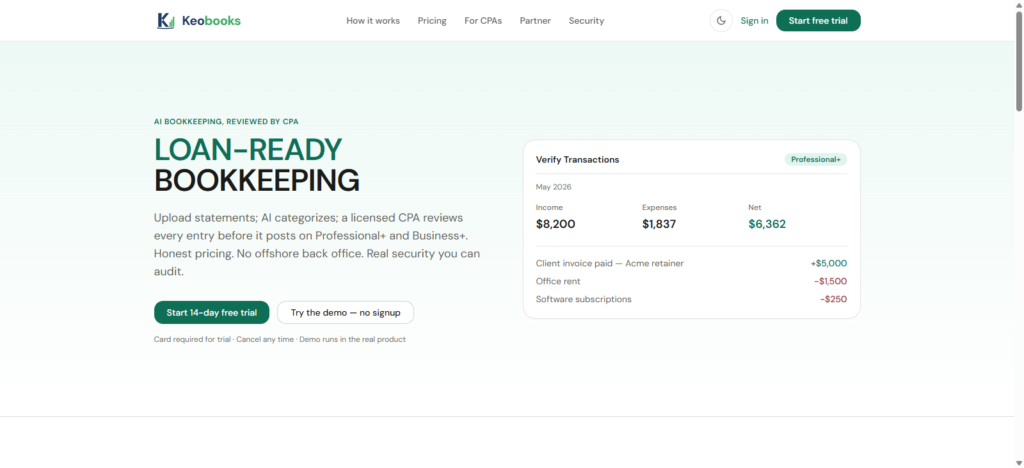
How KeoBooks Fits Into Your Financial Workflow
One of the biggest mistakes small businesses make is waiting until their bookkeeping becomes overwhelming before improving their system.
By then, you may have months of transactions to organize, receipts to find, accounts to reconcile, and financial information to clean up.
Using bookkeeping software early can help you establish better financial habits while your business is still manageable.
KeoBooks is designed to help businesses organize and manage their bookkeeping in a more efficient way.
Instead of treating bookkeeping as something you only worry about at tax time, you can make it part of your regular business operations.
That can mean spending less time searching through spreadsheets and scattered records and more time understanding what’s happening financially.
And as your business grows, having an organized bookkeeping system can make it easier to work with a professional bookkeeper or accountant when you need one.
Bookkeeping vs Accounting: You May Need Both
It’s easy to think of bookkeeping and accounting as competing choices.
They aren’t.
For many businesses, they work best together.
Your bookkeeping provides the accurate financial records your business needs.
Your accounting turns those records into useful financial information and advice.
The key is determining how much support your business needs at its current stage.
A new business may start with bookkeeping software and occasional help from an accountant.
As the business grows, it may add a bookkeeper.
As financial complexity increases, an accountant may become more involved in planning, tax strategy, reporting, and business decisions.
Your financial system should evolve as your business does.
How to Choose the Right Bookkeeping Software for Your Business
If you’re going to manage your bookkeeping with software, don’t choose a platform simply because it has the lowest monthly price.
Consider what your business actually needs.
a. Look for Automation
The software should reduce repetitive work rather than simply move your spreadsheets online.
b. Check Reporting Features
You should be able to access financial information that helps you understand your business.
c. Consider Ease of Use
If the software is difficult to understand, you may not use it consistently.
d. Think About Growth
Choose a system that can continue supporting you as transaction volume and business complexity increase.
e. Consider Professional Access
If you work with a bookkeeper or accountant, consider whether they can easily access the financial information they need.
f. Look at the Overall Value
Don’t only compare subscription prices. Consider the time saved, organization gained, and potential reduction in manual work.
A Simple Way to Think About Your Business’s Needs
Still not sure whether you need bookkeeping, accounting, or both?
Start with these questions:
Do I need someone to organize and record my financial transactions?
That’s bookkeeping.
Do I need someone to analyze my financial information and help me understand what it means?
That’s accounting.
Do I want to reduce the amount of repetitive bookkeeping I have to do manually?
That’s where bookkeeping software can help.
Do I have tax, financial planning, or complex business decisions that require professional guidance?
That’s where an accountant can add value.
For many growing small businesses, the answer isn’t choosing one over the other.
It’s building a financial system where software, bookkeeping, and accounting support each other.
Final Thoughts
When your business is small, it’s easy to handle everything yourself.
You might record expenses in a spreadsheet, send invoices manually, and check your bank account whenever you need to know how much money you have.
But growth changes things.
More customers create more transactions. More transactions create more bookkeeping. More bookkeeping creates more opportunities for errors and delays.
That’s why it’s worth building a better financial system before you desperately need one.
Bookkeeping keeps your financial records organized. Accounting helps you understand those records and make better decisions. Bookkeeping software can help streamline the work that happens between the two.
You don’t necessarily need a full finance department to run a financially organized small business.
You need the right tools and the right level of support for where your business is today and a system that can grow with you tomorrow.
If you’re looking for a way to simplify your day-to-day bookkeeping and keep your business finances organized, KeoBooks can help you build a more efficient bookkeeping workflow without making financial management unnecessarily complicated.
Ready to Spend Less Time on Your Books?
Your business is growing. Your bookkeeping should grow with it.
Explore KeoBooks and take a simpler approach to managing your business finances.
gggmdfozsskxguxixzwxxdzflwgkpd